Reading the water
Field guide · The big picture
Learn to Surf on Florida's East Coast
If you want to learn to surf, Florida's East Coast is about as forgiving as the sport gets: warm water most of the year, small waves that break over sand instead of reef, and enough rideable days to practice in every season. Daytona Beach, home beach of Vast Oceans Surf and SUP, puts all of that one hour east of Orlando.
This guide covers why this coast works so well for beginners, the fundamentals every new surfer here learns first, and how people actually progress, from a first lesson to a multi-day surf camp to real coaching.
01: Why this coast
Why is Florida's East Coast a good place to learn to surf?
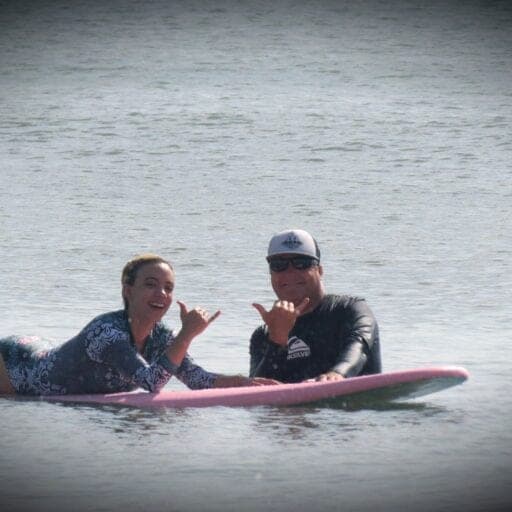
Start with the bottom. From Jacksonville down through New Smyrna, the waves break over sandbars: no coral heads, no rock slabs, no urchins. When you fall (and learning to surf is mostly falling with increasing style), you land in water over sand. That one fact removes most of what makes learning intimidating at the famous destination surf spots.
Then the waves themselves. Atlantic swell on this coast is usually small and crumbly. Waist-high is a perfectly normal day. Experienced surfers grumble about that; beginners should celebrate it. Small, soft waves give you long, gentle rides with time to think, which is exactly what the learning curve needs. And when fall hurricane swell or a winter nor'easter does light the coast up, there's a next level waiting right here, no plane ticket required.
Finally, the calendar. The water here is warm enough for boardshorts roughly half the year and never gets truly hostile. A wetsuit handles the winter months, and we provide them. Compare that with learning somewhere you'd wear a thick wetsuit most of the year, and the East Coast case makes itself.
✕ RIP CURRENTS RUN STRONGEST BESIDE INLETS AND JETTIES. IF CAUGHT, SWIM PARALLEL TO SHORE, NOT AGAINST THE PULL. LESSONS STAY ON LIFEGUARDED OPEN BEACH.
02: Why Daytona
Why learn in Daytona Beach specifically?
Daytona's beach is wide, flat, and long: miles of sandbar peaks, so a lesson never has to fight a crowd for waves. Our classroom is Sunsplash Park: we meet at the south-end picnic tables by the showers and beach stairs, parking is free, and Volusia County's Lifeguard Headquarters anchors the north end of the same beach. Waist-deep water over a gentle inside bar is where every first-timer starts.
It's also genuinely easy to get to, about an hour east of Orlando, Disney, and Universal, which is why so many of our students fold a surf lesson into a Florida vacation. Lessons are by appointment, so call ahead and Ryan will fit you in around the tide. If you want to time it well, our Daytona Beach conditions guide breaks down the seasons.
03: The fundamentals
What do you learn first?
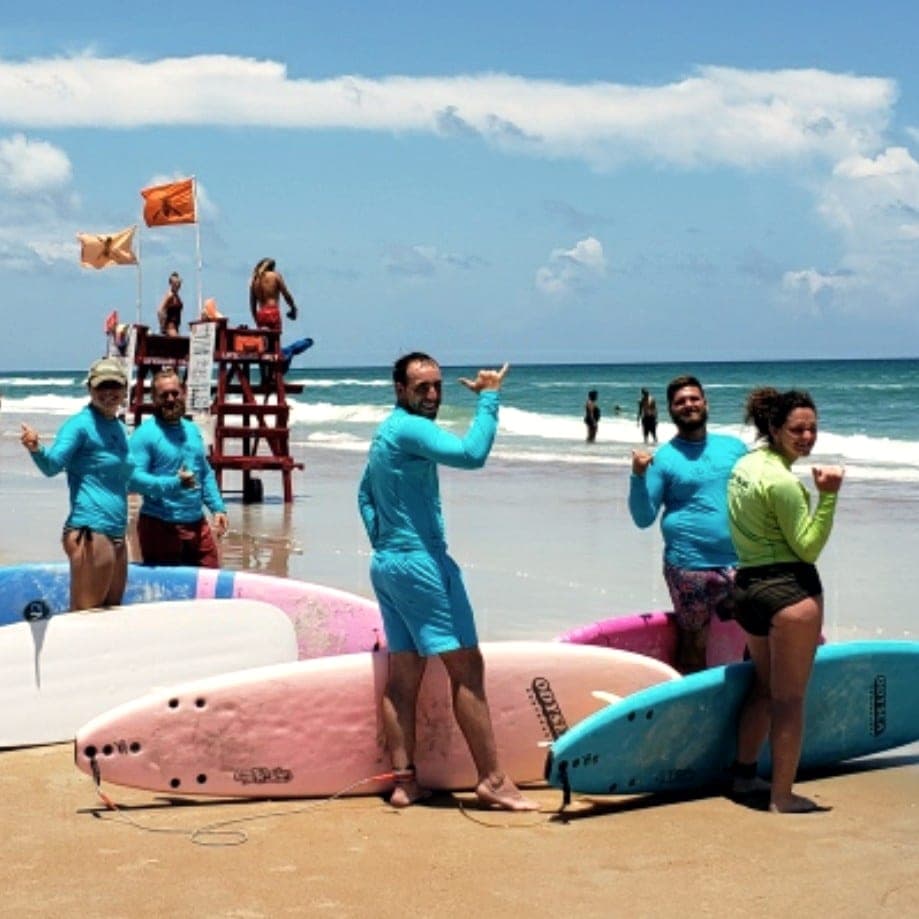
Ryan's teaching emphasis has always been technique and style, building habits that scale from your first whitewater ride to real waves. These are the fundamentals every new surfer on this coast works through, and they're where every Vast Oceans lesson begins.
Positioning on the board
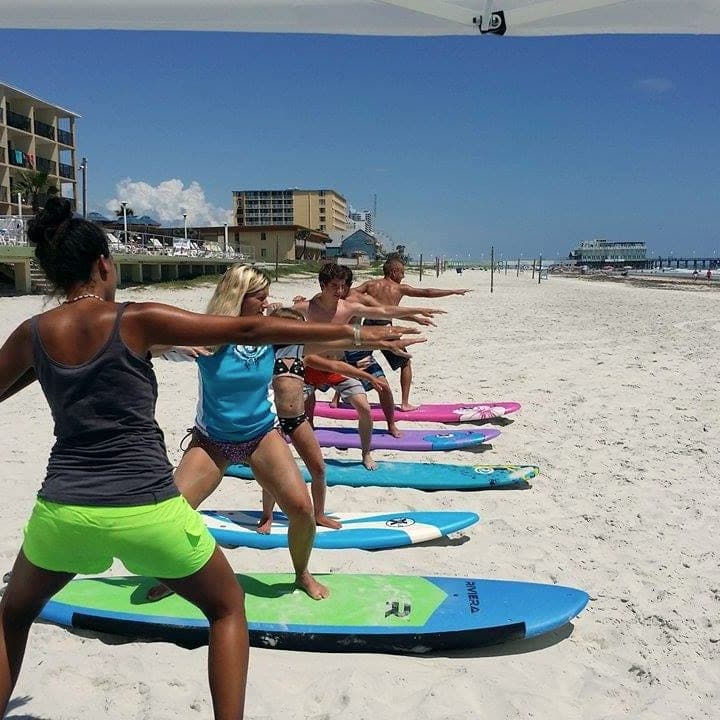
Where you lie on the board decides everything that follows. Legs and feet together, body centered, toes at the tail, and enough weight back that the nose doesn't dig in when a wave picks you up. Too far forward and you nose-dive; too far back and you push water and miss the wave entirely. Getting this dialed is half the battle of catching waves early on, which is why it's drilled on the sand before you paddle out.
Falling safely
Even in soft Florida waves, falling technique matters more than beginners expect, because the water is shallow. Fall flat, like a gentle belly flop, or flat onto your back; never dive headfirst, and cover your face and head with your hands and forearms. Shallow sandbars are forgiving to flat falls and unforgiving to headfirst ones. This is the first thing covered in the beach tutorial, every lesson, no exceptions.
Reading tides, wind, and waves
Waves change with the tide: rising and falling water levels change the shape and pitch of a breaking wave, so a spot that's mushy at low tide can line up nicely at mid. Wind matters even more. Onshore wind, blowing in off the ocean, chops the surf up and makes it rough, while light offshore wind grooms the faces clean. Learning to glance at the tide chart and wind forecast before you drive to the beach is the first skill that turns you from someone who owns a surfboard into a surfer.
Etiquette and ocean sense
Surfing has traffic rules. Don't drop in on the rider already up and closest to the peak, look down the line before you go, and stay out of the way when you're paddling back out. Skills like duck-diving under oncoming waves come later (that one takes real practice), but etiquette starts on day one. It's what keeps a crowded lineup friendly, and it's part of every lesson we teach.
04: The progression
The progression path: from first wave to real coaching
Nobody's surfing journey is a straight line, but on this coast the path has three reliable steps.
Step 1: take a first lesson
Every surfer's story starts with one wave that worked. A 1.5-hour surf lesson (beach-safety tutorial first, then coached water time, then a free half hour of practice when boards are free) gets most people to their feet on day one. Group lessons are $70 per person with all gear included. If you want the full play-by-play, we wrote out what to expect at your first surf lesson.
Step 2: stack days, not months
Skill comes from repetition while the feeling is still fresh. That's why we run surf camps for people of all ages, one, three, or five days ($80, $200, and $320, 2.5 hours a day), and why we tell adults the honest number: most people need one to three lessons to get comfortable on the board, and then it's practice. Surfboard rentals keep you in the water between sessions without buying a board on day two.
Step 3: coaching, when you're ready to push
Once you're catching unbroken waves on your own, generic lessons stop moving the needle. That's where surf coaching comes in: an inquiry-only program Ryan shapes around your age, your skill level, and your goal, whether that's competing or simply surfing better. It starts with a conversation, not a price list. And when conditions call for a better wave, coaching sessions often run at Ponce Inlet, which holds a smaller, cleaner summer swell than the open beach.
“Both of them were surfing within an hour and then he worked with them to really dial in their form for the next 30 mins.”
05: Field questions
Learning to surf in Florida FAQ
Q.01How long does it take to learn to surf?
Most students ride their first waves in lesson one and feel comfortable on the board within one to three lessons. Surfing unbroken “green” waves independently usually takes a season of regular practice, and the East Coast's gentle waves make that season a pleasant one.
Q.02Do I need to buy a surfboard to learn?
No. Every lesson includes a soft-top board and leash, and we offer surfboard rentals by the hour or overnight so you can practice between lessons before committing to a board of your own.
Q.03When is the best time of year to start surfing in Florida?
Any month works. That's the point of this coast. Summer has the warmest water and the gentlest waves, fall adds cleaner swell, and winter just means a wetsuit, which we provide. Lessons run year-round.
Q.04Is Florida's East Coast too small or flat to become a real surfer?
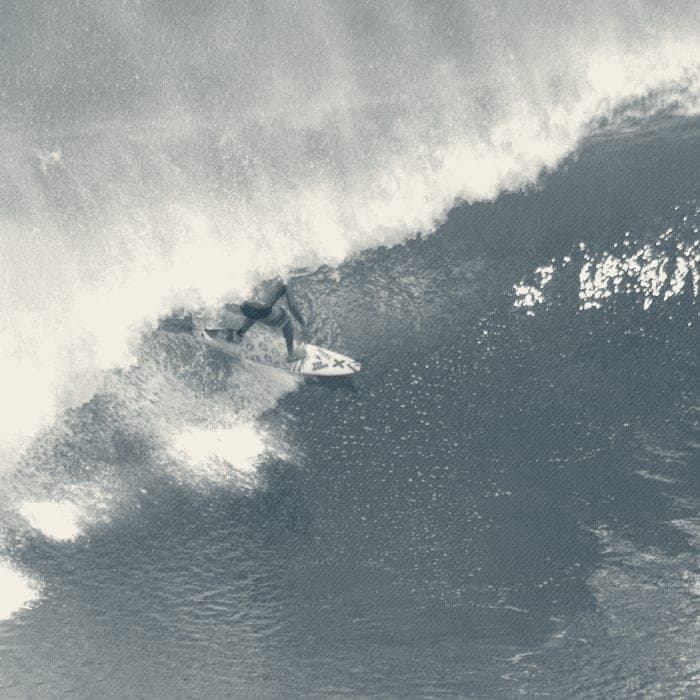
No, Florida beach break has produced generations of world-class surfers, including some of the best ever. Small waves force clean technique, and when you eventually travel to bigger surf, that technique goes with you.
Q.05Do you teach adults, or just kids?
Both. Lessons run from age 7 up, with no upper limit. Plenty of our first-timers are parents who booked a lesson for the kids and got talked onto a board themselves.
Start with one wave
386-308-9951Every surfer's story starts with one lesson. Call Ryan to set a time (lessons are by appointment) or send a lesson request online. Group lessons are $70 per person, all gear included.